
 admin
A cannabis leaf is easy to recognize in a logo. Identifying one on a real plant is surprisingly less straightforward. Young leaves may have only one or three leaflets, mature leaves can carry many more, and several unrelated plants share the same finger-like silhouette. Even when a leaf unquestionably belongs to cannabis, its appearance cannot tell you the plant's exact genetic ancestry or cannabinoid content.
This guide explains what to look for, which details matter most, and where popular cannabis-leaf identification advice goes too far. Rather than relying on a single photograph or leaflet count, you'll learn to evaluate the whole leaf and the plant it came from.
Quick answer: Cannabis typically has palmately compound leaves: several separate, narrow-to-elliptical leaflets spread from a shared point, often with pointed tips and sharply serrated edges. Mature leaves commonly have three to seven leaflets, though more are possible. No single feature confirms an identification, and leaf width alone cannot prove that a plant is indica or sativa.
What Does a Cannabis Leaf Actually Look Like?
The iconic cannabis fan leaf resembles an open hand. Each apparent “finger” is a leaflet, while the complete structure is one compound leaf. The leaflets typically radiate from a common point at the end of a stalk called a petiole. Many have a conspicuous central vein, smaller branching veins, a tapered tip, and tooth-like edges.
Those details are more useful than the overall outline. A leaf with five pointed sections might be cannabis, but it could just as easily belong to a plant with five lobes rather than five separate leaflets. That distinction becomes essential when comparing cannabis with kenaf or roselle hibiscus.
The University of Florida's botanical identification guide describes cannabis leaflets as commonly numbering three to seven, sometimes reaching eleven, with coarsely serrated margins and visible veins. Real plants vary considerably, so the description is a collection of clues rather than a foolproof checklist.
Seven Visual Clues for Cannabis Leaf Identification
1. Separate leaflets spread from one point
Start where the leaflets join. On a typical mature cannabis fan leaf, each slender segment is a separate leaflet attached near a shared point. This is called a palmately compound leaf. Compare it with a deeply lobed leaf: lobes are still connected by one continuous leaf blade, even when the cuts between them are deep.
This is one of the quickest ways to distinguish cannabis from some plants that appear almost identical from a distance.
2. Notice the saw-toothed edges
Most cannabis leaflets have obvious serrations running along their margins. The teeth tend to angle toward the leaflet tip. You might not notice them in a distant photograph, but a clear close-up often reveals the repeated pattern.
Serrations are useful supporting evidence, not proof. Virginia creeper also has toothed leaflets, while leaf damage can make an otherwise smooth edge look irregular.
3. Check the shape of individual leaflets
Cannabis leaflets are generally elongated, tapering toward pointed tips. Some appear relatively broad, while others are long and narrow. The central leaflet is often among the longest, giving the fan leaf its familiar spread.
Look at more than one mature, undamaged leaf before deciding whether a plant has characteristically broad or narrow leaflets. A single distorted or very young leaf is a poor sample.
4. Follow the vein pattern
Each leaflet generally has a prominent midrib, with smaller veins branching outward. The arrangement of the veins, serrations, and separate leaflet bases helps distinguish a true compound leaf from a single leaf with deep cuts.
For an identification photograph, include one whole leaf and a second close-up showing the leaflet base and margin. A picture of the silhouette alone leaves out important evidence.
5. Count the leaflets, but don't overinterpret the number
Three, five, seven, and nine leaflets are all discussed in cannabis identification. Some leaves may have just one, and mature specimens can show eleven or more. The European Union's plant-variety examination protocol explicitly records leaflet-count classes from three or fewer to eleven or more.
That does not mean five fingers prove indica, or seven fingers prove sativa. Leaflet number varies with the plant, the leaf's position, its developmental stage, and the genetic background. The most useful count comes from representative, fully developed leaves—not whichever leaf looks most dramatic.
6. Look at where leaves attach to the stem
Leaf arrangement provides another clue. Cannabis may show opposite pairs of leaves at some stages and alternate leaves at others. That variation is one reason plant-identification references describe its leaves as either opposite or alternate.
Instead of insisting on one attachment pattern, examine the stem, several leaves, and other visible plant features together. This also helps avoid confusing a branching stem with a single compound leaf.
7. Use the whole plant as supporting evidence
An isolated leaf may not give enough information. Whether the plant is a vine, a woody shrub, or an upright herb can significantly narrow the possibilities. Flowers and fruit are especially helpful when present. A five-leaflet climbing vine with berry-like fruit, for example, deserves a very different identification process from an upright cannabis plant.
Where identification matters for legal, conservation, or land-management reasons, a clear specimen record or qualified botanical identification is preferable to guessing from social-media photos.
Why Do Cannabis Leaves Have Three, Five, Seven, or Nine Fingers?
The word “fingers” is convenient, but leaflets is botanically correct. A young cannabis plant can begin with simple leaves before developing the more familiar compound fan leaves. The number of leaflets seen on later leaves can differ from those on early leaves, and not every mature leaf on one plant needs to look identical.
It helps to separate three questions: How many leaflets does this particular leaf have? Is it fully developed? And does it resemble other leaves from the same plant? Only then does counting offer useful context.
| Visible leaflet count | What it can tell you | What it cannot prove |
|---|---|---|
| One or three | May occur on young or otherwise variable leaves | That the plant belongs to a particular indica/sativa category |
| Five | A commonly observed compound-leaf pattern | That the plant is genetically “indica” |
| Seven | Another familiar mature-leaf pattern | That the plant is genetically “sativa” |
| Nine or more | A higher leaflet count within documented variation | High potency, high quality, or specific effects |
A leaflet count works best as one descriptive note in a larger set of observations. It is not a chemical test or an ancestry report.
Plants That Look Like Cannabis: Four Common Confusions
Some of the hardest identification mistakes happen because unrelated plants share palm-shaped leaves. The University of Florida lists several such lookalikes. These four illustrate why closer inspection matters.
| Lookalike | Why it gets confused | Useful distinguishing clue |
|---|---|---|
| Kenaf (Hibiscus cannabinus) | Narrow, deeply cut leaf sections resemble cannabis fingers | Its leaves are lobed rather than made of separate leaflets; flowers are hibiscus-like |
| Roselle (Hibiscus sabdariffa) | Several pointed lobes may create a fan-like outline | The lobes form one continuous blade, and its flowers differ from cannabis |
| Virginia creeper (Parthenocissus quinquefolia) | Usually five separate, serrated leaflets | It is a climbing vine, with generally broader leaflets and fleshy fruit |
| Chaste tree (Vitex agnus-castus) | Narrow leaflets radiate from a shared point | A woody shrub or small tree with mostly non-serrated leaflet edges and distinctive flower clusters |
Be cautious with images taken from above: perspective can hide whether a leaf is lobed or compound. If possible, look at the junction where the leaf sections meet, the stem, and any flowers or fruit. Those details often reveal more than color or total leaflet count.
Can Leaf Shape Tell You Whether a Plant Is Indica or Sativa?
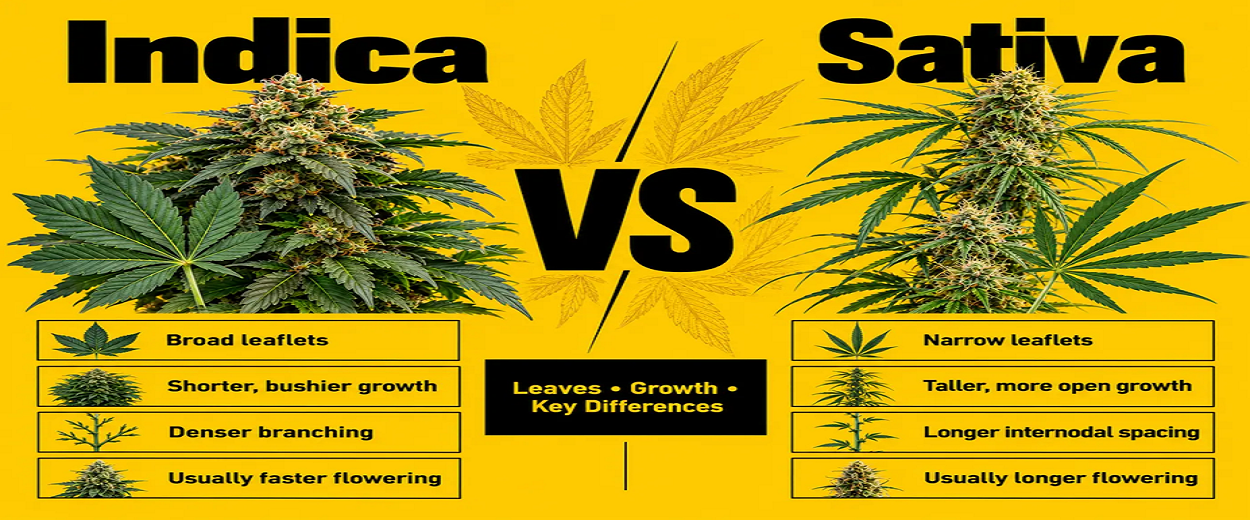
Not with certainty. In everyday cannabis descriptions, indica-associated plants are often pictured with relatively broad leaflets, while sativa-associated plants are depicted with longer, narrower ones. Those are familiar visual tendencies, but contemporary hybrids can display a mixture of traits.
If you're trying to understand how can you tell indica from sativa, it helps to compare leaflet width alongside plant structure and documented cultivar information, while recognizing that appearances alone cannot establish genetic ancestry. The linked PrimeStrains guide examines the broader plant differences and the limitations of those labels.
There is good reason for caution. A 2021 study published in Nature Plants analyzed more than 100 cannabis samples and found that those labeled sativa and indica did not separate clearly on a genome-wide scale. The study did identify associations between commercial labels and certain terpene patterns, but this does not make leaf shape a reliable measure of chemical content or personal effects.
Keep the distinction simple: leaf morphology describes what you can see; genetic ancestry and cannabinoid composition require different evidence. Neither a broad leaflet nor a narrow one is a laboratory result.
Fan Leaves vs. Sugar Leaves: What's the Difference?
The familiar spread-out leaves used in cannabis illustrations are usually fan leaves. They have a noticeable petiole and multiple leaflets, and they provide a convenient view of overall leaf form. Sugar leaves are smaller leaves associated with flower clusters and are commonly discussed because they may carry visible glandular trichomes.
These are descriptive terms for leaf placement and appearance, not separate species or proof of an indica/sativa identity. When comparing leaflets for identification, use clearly documented, representative leaves rather than mixing a small flower-associated leaf with a large fan leaf.
Can You Tell Hemp From Marijuana Just by Looking at a Leaf?
No. Both refer to cannabis, and visual differences among plants do not establish the chemical threshold used in a particular jurisdiction's legal definition. Two plants can have similar leaves yet very different tested cannabinoid profiles. Conversely, different-looking cannabis plants may fall into the same legal classification.
That distinction matters because a photograph cannot establish THC concentration. Legal definitions also vary across jurisdictions and can change over time, so visual identification should never be treated as a substitute for relevant testing or local legal guidance.
A Simple Photo Checklist for More Accurate Identification
Whether you're comparing botanical photographs or reviewing an unidentified specimen, use a repeatable method instead of relying on a single striking feature:
- Look at a clear photograph of the entire plant, not just one detached leaf.
- Check whether the apparent fingers are separate leaflets or connected lobes.
- Examine the margin and tip of at least one well-focused leaflet.
- Record leaflet count without assigning an indica/sativa label from it.
- Notice stem arrangement, growth habit, and any visible flowers or fruits.
- Compare the complete set of traits with reliable botanical references.
For a difficult specimen, a regional plant-identification key or herbarium collection can be more informative than an image search. The goal is to confirm the plant, not to force it into the first familiar label.
Frequently Asked Questions
Does every cannabis leaf have seven fingers?
No. Cannabis leaves vary, and seven leaflets are only one common pattern. Plants can produce leaves with fewer or more leaflets, depending on the leaf and the plant's characteristics.
Are all cannabis leaves serrated?
Coarsely serrated leaflet edges are a typical feature described in botanical references. Yet damage, poor images, and atypical leaf development can make the pattern difficult to assess. Always check other identifying features too.
Can a narrow cannabis leaf prove a plant is sativa?
No. Narrow leaflets may resemble traditional sativa-associated descriptions, but the appearance cannot confirm a seed label, exact ancestry, cannabinoid level, or likely effect.
What looks like a marijuana leaf but isn't?
Kenaf, roselle hibiscus, Virginia creeper, and chaste tree can each resemble cannabis in some photographs. Compare whether the leaf is compound or lobed, and inspect the whole plant's growth habit.
Can you identify a cannabis strain from a photograph?
Not reliably. Images can document physical traits, but many cultivars share similar appearances. An exact strain or cultivar claim needs trustworthy provenance beyond a visual guess.
The Bottom Line
Accurate cannabis-leaf identification starts with observing several features together: separate leaflets, toothed edges, pointed tips, vein patterns, attachment to the stem, and the form of the whole plant. Leaflet numbers help describe what you're seeing, but they are not a shortcut to strain identity or potency.
Most importantly, don't confuse identification with classification. You may recognize a cannabis leaf with reasonable confidence without being able to label its genetic ancestry. A careful description of what's visible is more valuable than an impressive-sounding but unsupported conclusion.
Botanical and scientific references
- University of Florida IFAS, Cannabis sativa Plant Identification and Its Look-Alikes.
- Community Plant Variety Office, Technical Protocol for Distinctness, Uniformity and Stability: Cannabis, leaflet-count descriptions.
- Watts et al. (2021), Cannabis labelling is associated with genetic variation in terpene synthase genes, Nature Plants.